Vİ: Digitalization without compromise?
Global supply chains, shorter innovation cycles and increasing regulatory requirements are making reactive Life-Cycle Management ever more challenging. As a new end‑to‑end digital platform, Vİ enables the intelligent use of relevant data and brings components under active management. At the same time, advanced intelligence must never come at the expense of protecting data from external exposure.
System architecture built on principles
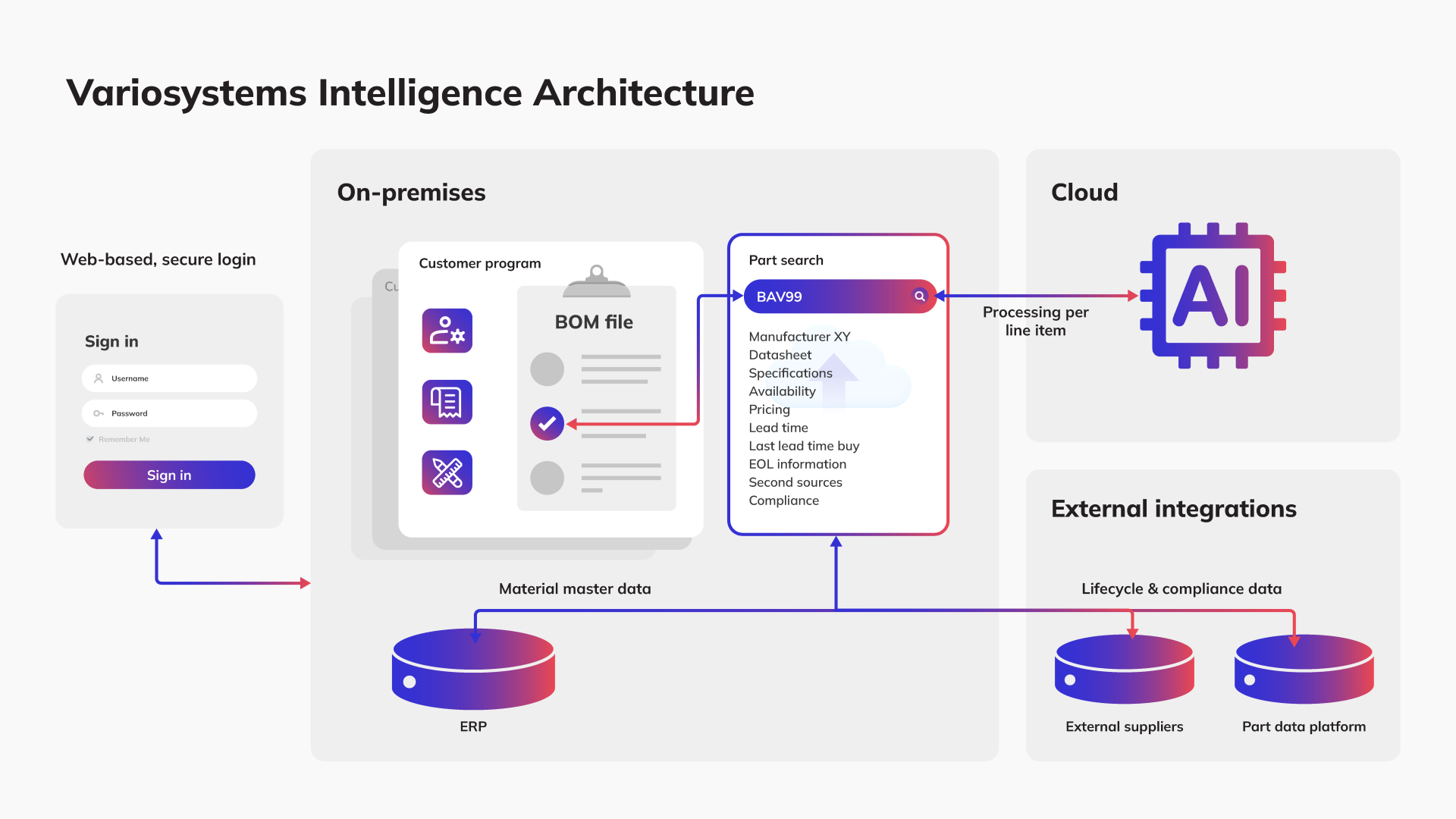
Variosystems Intelligence is intentionally based on a hybrid architecture designed from the very beginning for consistent data sovereignty and clearly defined data flows. This approach is complemented by a dedicated server infrastructure and clearly defined security mechanisms, creating the foundation for cloud and AI readiness.
“We defined the architecture in a way that sensitive manufacturing details and bills of materials remain consistently on‑premises and therefore fully under our control,” explains Toni Gantenbein, Business Excellence Consultant and Architect at Variosystems. “The selective use of AI in the cloud is limited exclusively to filtered queries at the individual component level. AI enhances our existing data with intelligent analysis, without accessing raw data.”
The multi‑layer system architecture clearly separates data storage, access, processing and analysis. Manufacturing information and material data are integral parts of the on‑premises architecture. When searching for relevant components, the system incorporates information from external manufacturers, lifecycle data, and compliance data without the bill of materials ever leaving the on-premises environment. Only component‑level data queries are forwarded to external sources. AI‑based analysis significantly improves component search by making it easier to identify and evaluate alternatives. AI acts as separate analytics layer rather than a data‑holding system, as its design is intentionally focused on security and traceability.
Digitalization without data loss?
Digitalized processes create transparency. However, the use of AI often conflicts with data security and confidentiality, as many systems necessarily shift data into external cloud environments.
Vİ’s on‑premises approach is therefore not a technical relic, but a deliberate strategic decision—particularly to meet the requirements of customer projects in Aerospace & Defense, Medtech & Life Science, and Industrial & Automation.
“Digitalization is only sustainable when it is aligned with real‑world requirements. Our customers operate in environments where trust, regulatory security and reliability are non‑negotiable. This reality forms the basis of our technological and architectural decisions,” emphasizes Natascha Chiodin, Head of Business Excellence at Variosystems.
Platform strategy instead of a fragmented tool landscape
Rather than relying on a collection of isolated tools, Variosystems intentionally pursues an integrated platform strategy. Through ERP integration (SAP S/4HANA 2025 FSP01), Vİ not only consumes data from the system but also feeds information back in a structured and traceable way. This reduces redundant data handling, increases process reliability and creates a consistent, globally unified data foundation.
From reactive administration to active control
Lifecycle and compliance risks often become visible only when room for action is already limited. With Vİ, this information is shifted into the early phases of product development, making changes in the supply chain visible in time, before they turn into costly problems.
When components change, engineering services are involved at an early stage and appropriate measures are prepared in a structured manner. Lifecycle management thus evolves into a continuous control instrument: forward‑looking, seamlessly integrated into existing processes and designed to support well‑founded decisions across the entire product lifecycle.

Julia is our Head of Global Marketing & Communications. She combines her strategic mindset with creative ideas and a deep understanding of design to drive communication and campaigns globally. Outside of work, Julia channels her energy into handball, where she coaches a girls’ handball team—always bringing not only tactics, but also her sense of humor to the court.