Mastering new electronic product introductions—how we accelerate innovation together
What is the NPI process?
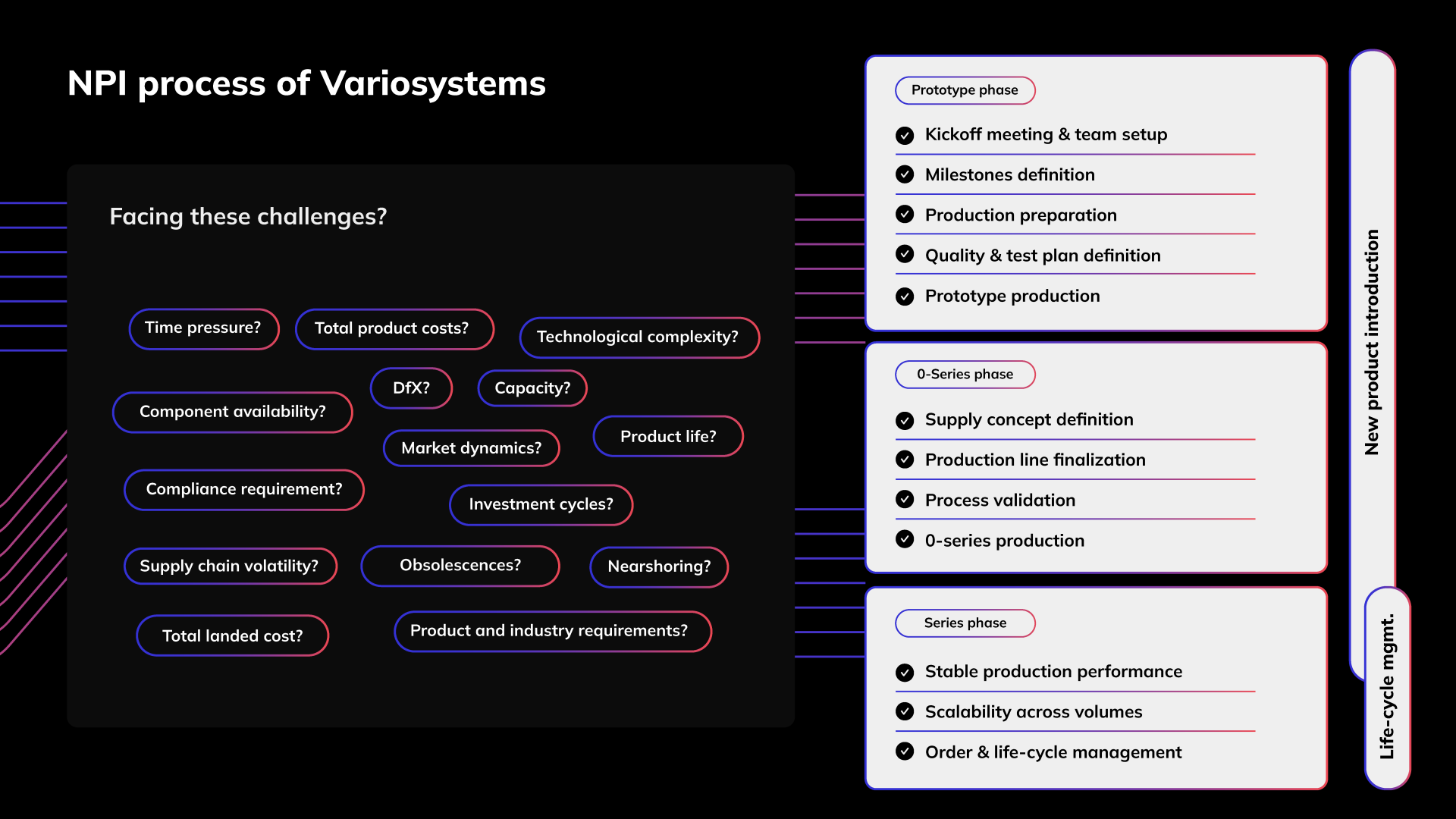
The NPI process provides a structured framework to guide your product from initial concept through to series production. Across clearly defined phases, specific measures and activities are applied to support development and ensure a smooth transition into manufacturing.
That’s because between concept and market launch lies a complex reality:
- multiple iterations,
- tight timelines,
- supply chain disturbances
- and uncompromising quality requirements.
Each delay can impact on the market entry. Each quality issue can affect brand trust. And each misalignment between development and manufacturing increases the risk of straying from the planned course.
A shared and well-defined approach to planning, product introduction, and electronics production helps to:
- set the right direction from the start
- reduce uncertainty in a targeted way
- control and minimize costs
- ensure efficient timelines
- secure a successful product implementation
Our approach: a mirrored NPI process built for industrialization
From the moment a customer project is initiated, industrialization and manufacturing are an integral part of the NPI. And you are supported by our dedicated Customer Success Team, working closely with our experts from Test Engineering, Product Quality Engineering, and Industrial Engineering. Together, they manage requirements, validate technical feasibility, and stabilize manufacturing processes as well as qualify the supply chain.

„Our NPI process is structured into three phases, from prototype to series production, designed to follow the same pace and milestones of our customers’ NPI journey. This creates a shared understanding, reduces friction across teams, and allows everyone involved to focus on execution rather than coordination.“
— Josipa Maršanić, Head of Quality & ESG.
Structured phases, clear ownership, and high quality standards
1. Prototype development: Get a clear picture early on
In the prototype phase, our focus is on speed and, above all, early stabilization. By integrating manufacturing principles, technologies, functional requirements, potential risks, and testing considerations, we challenge assumptions while they are still easy to change. We’re using this phase to really try things out. And that’s important because it allows industrial risks to surface early and design decisions to be validated with a clear view on feasibility, repeatability, and future scalability. The result is a robust foundation for the entire NPI.
2. 0-series: Prove repeatability under real manufacturing conditions
The 0‑series phase is where concepts meet reality. Here, we demonstrate that the product does not only work once but can be built, tested, and produced consistently. Design concepts are industrialized through tailored processes, test strategies, and supply chain concepts validated under near‑series conditions, turning theoretical readiness into practical proof.
3. Series production: Secure stable quality and scalable performance over time
With all validations completed, the project transitions into series production. Our focus shifts from proving feasibility to securing long‑term performance. Processes are stabilized, quality targets are monitored, and scalability across volumes, lines, and sites is ensured.
Global standards with local execution
Our NPI approach combines global harmonization with local support. This allows us to ensure consistent processes and standards across all locations while enabling fast communication and agile decision-making. Every step is designed to be transparent, risk-aware, and scalable.
“Globally harmonized processes and tools give us structure and stability, but real progress happens locally. Local execution allows us to react quickly and flexibly to our customers’ needs, address risks early, and keep momentum throughout the whole NPI journey,” adds Josipa Maršanić.
Accelerate your product launch with a proven NPI process
Choosing the right electronics manufacturing partner means ensuring your product launch happens on time and delivers the expected quality. From concept to launch, our NPI process minimizes risk and maximizes efficiency because your success matters to us. As your partner for innovation in the electronics industry, we align our services with your goals. You stay focused on your core business while we take care of the rest.
A successful series launch is not the end of our engagement. Through structured life‑cycle management, we actively support products throughout their market lifetime. Obsolescence management allows risks to be anticipated early, while changes are managed in a controlled manner, and continuous improvements are implemented without disrupting supply or quality.
So, are you ready to accelerate your next product launch?
Q&A